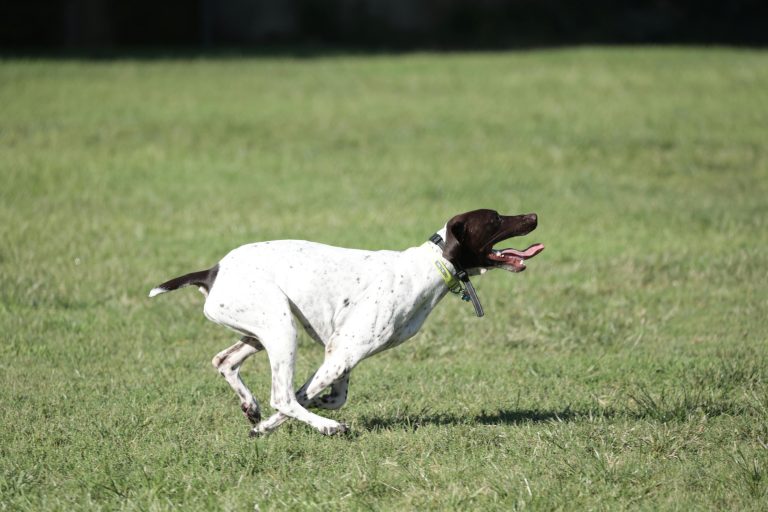
What Age Can You Use an E-Collar on a GSP? (Important Guidelines)
Introducing an e-collar too early can create confusion. Introducing it at the right time can make training clearer, safer, and more consistent.
For most German Shorthaired Pointers, the right time isn’t determined by age alone—it’s determined by training readiness.
Before you buy an e-collar, learn how to use one correctly. See the GSP E-Collar Training System.
The Short Answer
Most GSPs are ready for e-collar introduction between 5 and 7 months of age, after they reliably understand basic obedience commands.
A puppy that clearly understands recall and basic commands at 5 months may be ready sooner than a 7-month-old dog that still lacks a training foundation.
The key is understanding that an e-collar should reinforce known behaviors—not teach new ones.
If you’re unsure how to begin, see our complete guide on
What Your GSP Should Know Before Wearing an E-Collar
Before introducing stimulation, your dog should reliably understand:
- Come/here (recall)
- Kennel
- Heel
- Whoa (for hunting dogs)
The e-collar should never be used to teach these commands from scratch.
Instead, it acts as a communication tool that reinforces behaviors your dog already understands through leash work and repetition.
Many e-collar problems occur because owners move too quickly and expect the collar to teach the lesson.
Why Waiting Matters
German Shorthaired Pointers are intelligent, sensitive dogs with strong prey drive.
Using an e-collar before a puppy understands basic expectations can:
- Create confusion
- Cause avoidance behaviors
- Reduce confidence
- Slow overall training progress
A young GSP should first learn commands through positive repetition, consistency, and leash guidance.
Once those behaviors become familiar, the e-collar becomes a reinforcement tool—not a source of pressure.
How to Introduce an E-Collar Properly
When your GSP is ready:
1. Let Them Wear the Collar First
Allow your dog to wear the collar for several days without using any stimulation.
This helps prevent the dog from associating the collar with corrections.
2. Find the Working Level
Start at the lowest setting.
Gradually increase until you notice a subtle response such as:
- Ear twitch
- Head turn
- Brief pause
The correct working level should get your dog’s attention without causing fear or discomfort.
3. Pair It With Known Commands
Give a command your dog already understands.
Use low-level stimulation only as reinforcement and immediately release it when the dog responds correctly.
4. Keep Sessions Short
Short, successful sessions build confidence and understanding much faster than long training sessions.
For a complete step-by-step process, read
Is an E-Collar Necessary for a GSP?
Not every German Shorthaired Pointer needs an e-collar.
However, many owners find them extremely useful for:
- Recall training
- Off-leash freedom
- Hunting situations
- High-distraction environments
- Managing high-drive dogs safely
If your GSP regularly trains or hunts at distance, an e-collar can become one of the most valuable training tools you own.
Some owners who hunt large properties may also benefit from a GPS tracking system. Learn more in
Choosing the Right E-Collar
Not all training collars are created equal.
The best systems offer:
- Reliable stimulation
- Multiple training modes
- Consistent performance
- Durable construction
- Easy operation in the field
See our complete guide to the Best E-Collars for German Shorthaired Pointers for detailed reviews and recommendations.
Still unsure what stimulation level to use or when to correct?
The GSP E-Collar Training System removes the guesswork with a simple step-by-step process built specifically for German Shorthaired Pointers.
Learn how to introduce the collar properly, build reliable recall, and avoid the mistakes that confuse dogs and frustrate owners.
Final Thoughts
Most German Shorthaired Pointers are ready for e-collar training around 6 months of age, but age is only part of the equation.
A strong training foundation matters far more than a date on the calendar.
When introduced correctly, an e-collar becomes a communication tool that helps reinforce obedience, improve reliability, and create more freedom for your dog both in training and in the field.
Disclosure
This page contains affiliate links. If you purchase through these links, we may earn a commission at no additional cost to you.
We publish field-tested gear reviews, training guidance, and safety resources specifically for German Shorthaired Pointer owners who hunt, train, and live with their dogs year-round.